

There is something deeply comforting about a bowl of Bengali Bhaja Mung Dal Khichuri. It is warm, soft, fragrant, and deeply satisfying. The rice and lentils melt together as they cook, the roasted moong dal lends a subtle nutty aroma, and the final drizzle of ghee brings everything together.
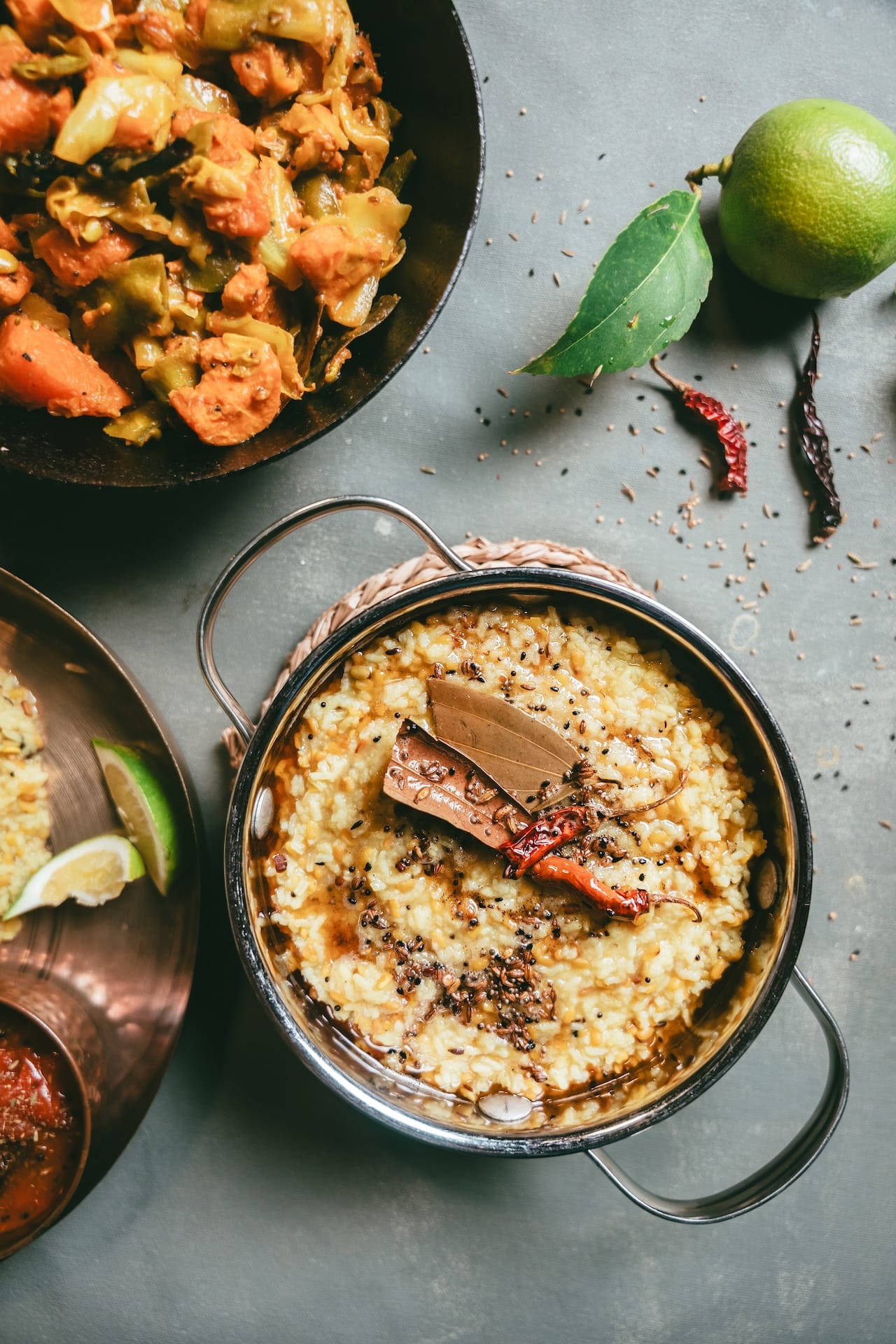
In Bengali homes, khichuri can mean different things depending on the season, occasion, and family. There is the simple everyday khichuri that needs little more than rice, dal, turmeric, salt, and a few spices. There is the vegetable-filled khichuri served on rainy afternoons. And then there is bhoger khichuri, the special Bengali khichuri associated with puja and festive meals.
This recipe sits comfortably among all of them.
What is Bhaja Mung Dal Khichuri
It is a Bhaja Mung Dal Khichuri, where bhaja refers to roasting the moong dal before cooking it with rice. That one extra step gives this humble rice-and-lentil dish an unmistakably different aroma and flavor.
The word bhaja means roasted or fried, mung dal refers to split yellow mung lentils, and khichuri is the Bengali word for the rice-and-lentil preparation.
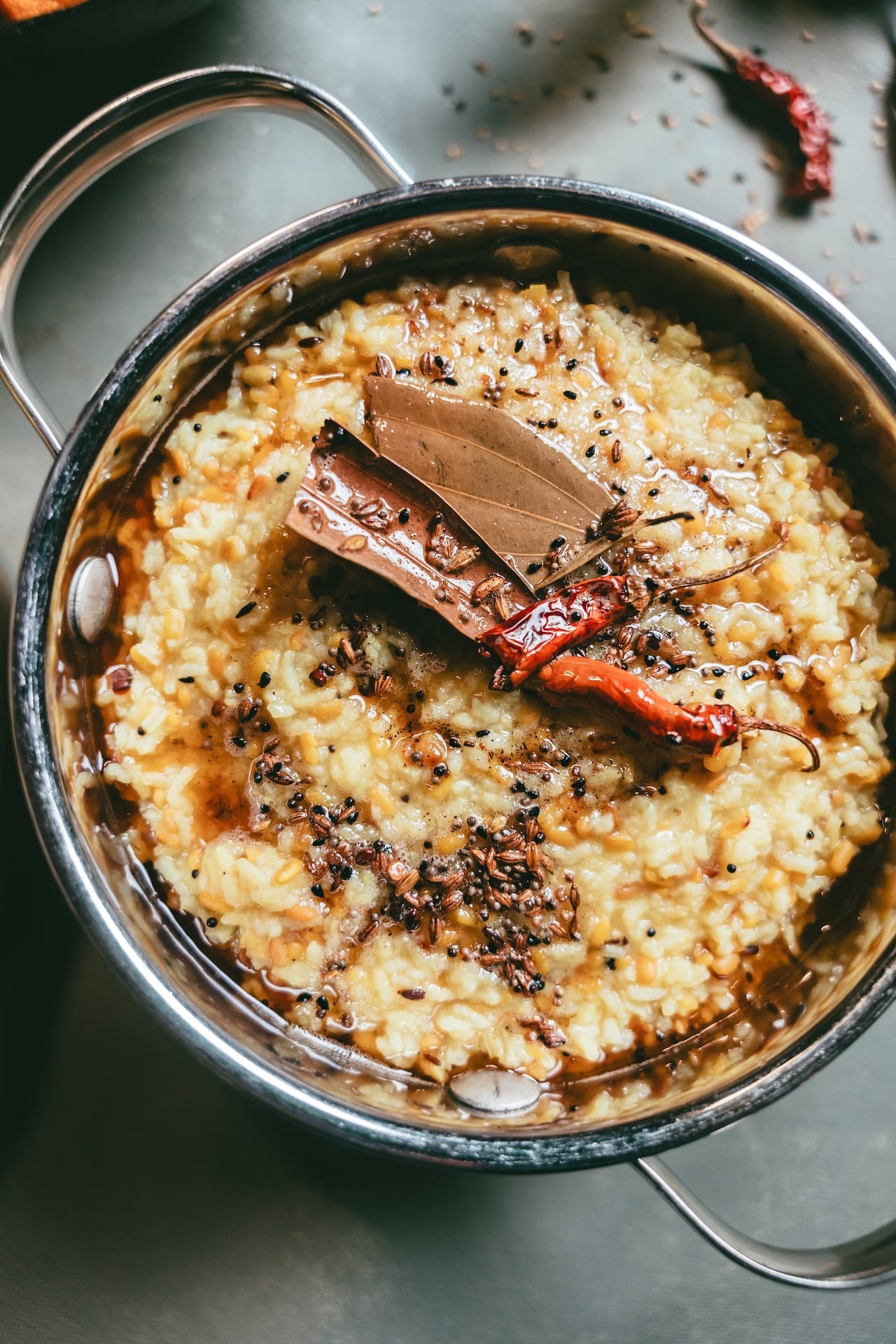
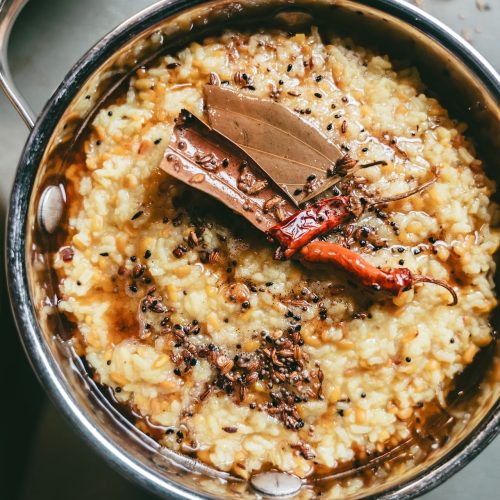
The dal becomes nutty and fragrant as it roasts, while the rice cooks into a soft, creamy consistency. A final tempering of ghee, panch phoron, dried red chilies, bay leaves, and fresh ginger perfumes the entire pot.
That aroma becomes the foundation of the finished dish.
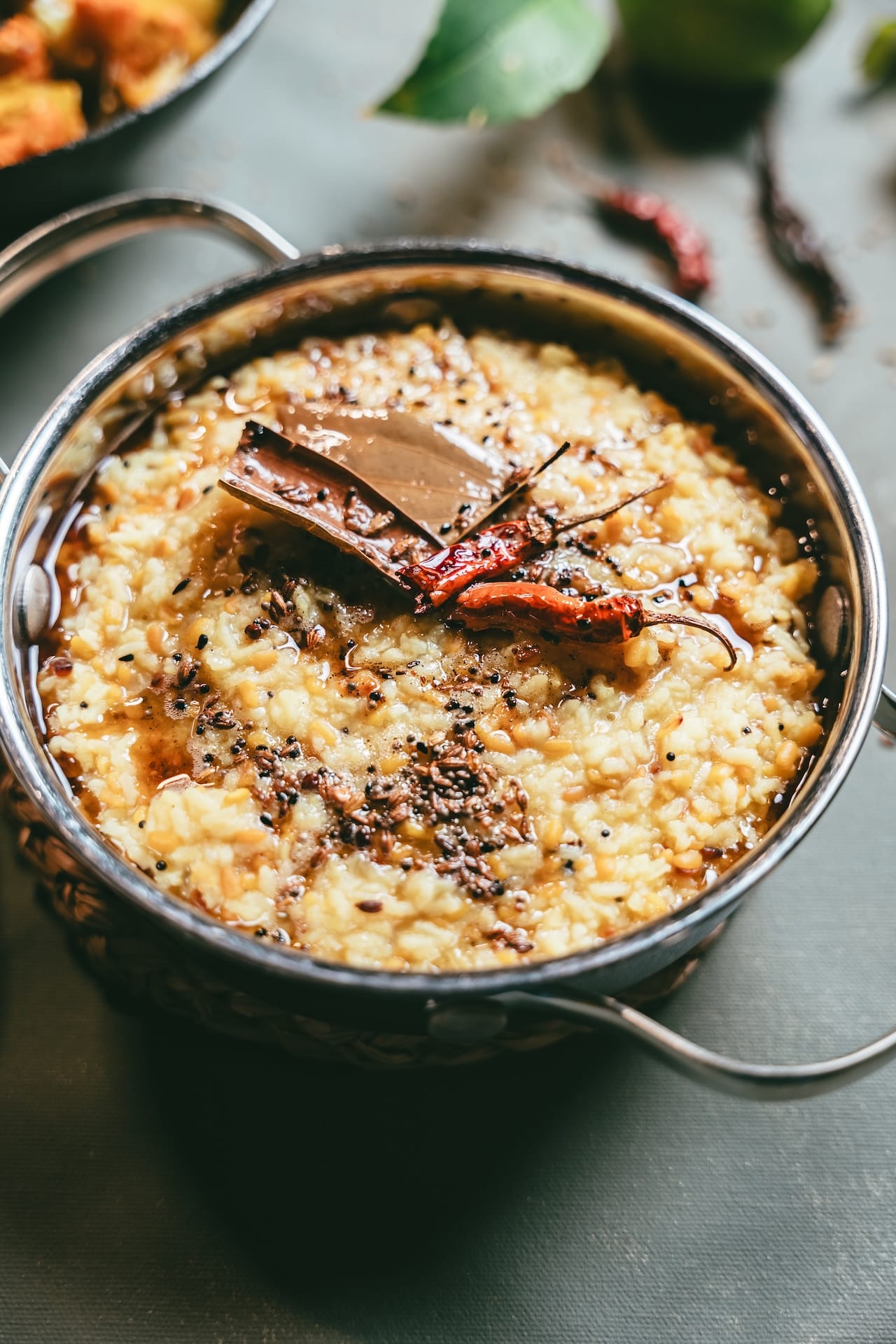
And if you serve it with begun bhaja, papad, pickle, labra, or tomato chutney, you have a meal that is comforting enough for a rainy evening and special enough for a Bengali festive table.
If you have never made Bengali-style khichuri before, don't be intimidated. The ingredient list is relatively short, and once you understand a few important techniques—especially how to roast the moong dal and how to judge the consistency—the recipe is very forgiving.
Why Roast the Moong Dal for Bhaja Mung Dal Khichuri?
This is probably the most important question when making this recipe.
Why not simply wash the dal and cook it?
Because roasting changes the flavor dramatically.
Raw moong dal has a mild, slightly grassy aroma. When you dry-roast it, the heat develops deeper toasted and nutty notes.
You will actually notice the transformation while roasting.
At first, the dal smells almost neutral.
Then, after a few minutes, you begin to smell a warm, nutty fragrance.
That is when you know you're getting close.
The goal is not to brown the dal heavily.
You want the lentils to become fragrant and lightly golden, not dark brown.
If you roast them too aggressively, the dal can develop a bitter, burnt flavor that will carry through the entire khichuri.
So keep the heat moderate, stir often, and pay attention to the aroma.
My biggest tip
Don't use a high flame just because you want the roasting to happen quickly.
Medium-low heat gives you much more control.
The dal will toast gradually and evenly, and you will have enough time to stop before it burns.
What Kind of Rice Should You Use?
Rice makes a surprising difference in khichuri.
For this Bengali-style preparation, I prefer short-grain rice because it cooks down beautifully and gives the khichuri that soft, comforting texture.
If you can find Gobindobhog rice, it is an excellent choice.
Gobindobhog is a fragrant short-grain rice traditionally associated with Bengali cooking. It has a wonderful aroma and works particularly well in preparations where you want the rice to become soft and creamy.
However, you absolutely do not need to search everywhere for Gobindobhog rice before making this recipe.
A good short-grain white rice works beautifully.
The goal is to make a delicious pot of khichuri, not to make the recipe unnecessarily difficult to reproduce.
Can you use basmati rice?
Yes, you can.
But the result will be different.
Basmati rice is long-grained and aromatic, and it tends to retain more of its individual grains. This isn't necessarily bad, but it won't give you the same soft, cohesive texture associated with Bengali khichuri.
If basmati is the only rice you have, use it.
But if you're shopping specifically for this recipe, choose a short-grain rice.
Ingredients You Need
The beauty of this khichuri is that it doesn't require a huge list of ingredients.
Here's what you need and why each ingredient matters.
Yellow Split Moong Dal
Use split yellow moong dal.
This is the dal that gets dry-roasted before cooking.
Roasting is what gives the dish its characteristic flavor.
Do not substitute whole green mung beans if you're looking for the same result. They require a different cooking approach and will give the khichuri a completely different flavor, texture, and appearance.
Short-Grain Rice
Short-grain rice gives the khichuri a soft, creamy texture.
Gobindobhog rice is ideal, but another short-grain rice is perfectly fine.
Turmeric
Turmeric gives the khichuri its beautiful golden-yellow color.
It also contributes a subtle earthy flavor.
You don't need a lot.
The finished dish should look warmly golden rather than intensely orange.
Fresh Ginger
Fresh ginger provides warmth and freshness.
I like to finely chop the ginger rather than make a smooth paste for this recipe because tiny pieces of ginger become wonderfully fragrant when fried in ghee.
Panch Phoron
If there is one spice blend that immediately makes me think of Bengali cooking, it is panch phoron.
The name literally means "five spices."
A traditional panch phoron blend includes:
- Fenugreek seeds
- Fennel seeds
- Nigella seeds
- Cumin seeds
- Black mustard seeds
The whole spices are added to hot fat, where they sizzle and release their aromas.
Because the spices are whole, they don't dominate the dish in the way a large amount of powdered spice might.
Instead, you get little bursts of flavor throughout the khichuri.
Ghee
Ghee is especially important in the finishing tempering.
It adds richness, but more importantly, it carries the aroma of the whole spices.
When panch phoron, dried chilies, bay leaves, and ginger sizzle in hot ghee, the fragrance is incredible.
You can make this recipe with oil, but if you're looking for that classic aromatic finish, ghee is hard to replace.
Bay Leaves
Bay leaves add a subtle background fragrance.
They are not intended to dominate the dish.
Dried Red Chilies
Dried red chilies provide warmth and a gentle smoky aroma.
You can use fewer if you prefer a milder khichuri.
You can also break them in half if you want the chili to release more heat.
How to Make Bhaja Mung Dal Khichuri
Step 1: Dry-Roast the Moong Dal
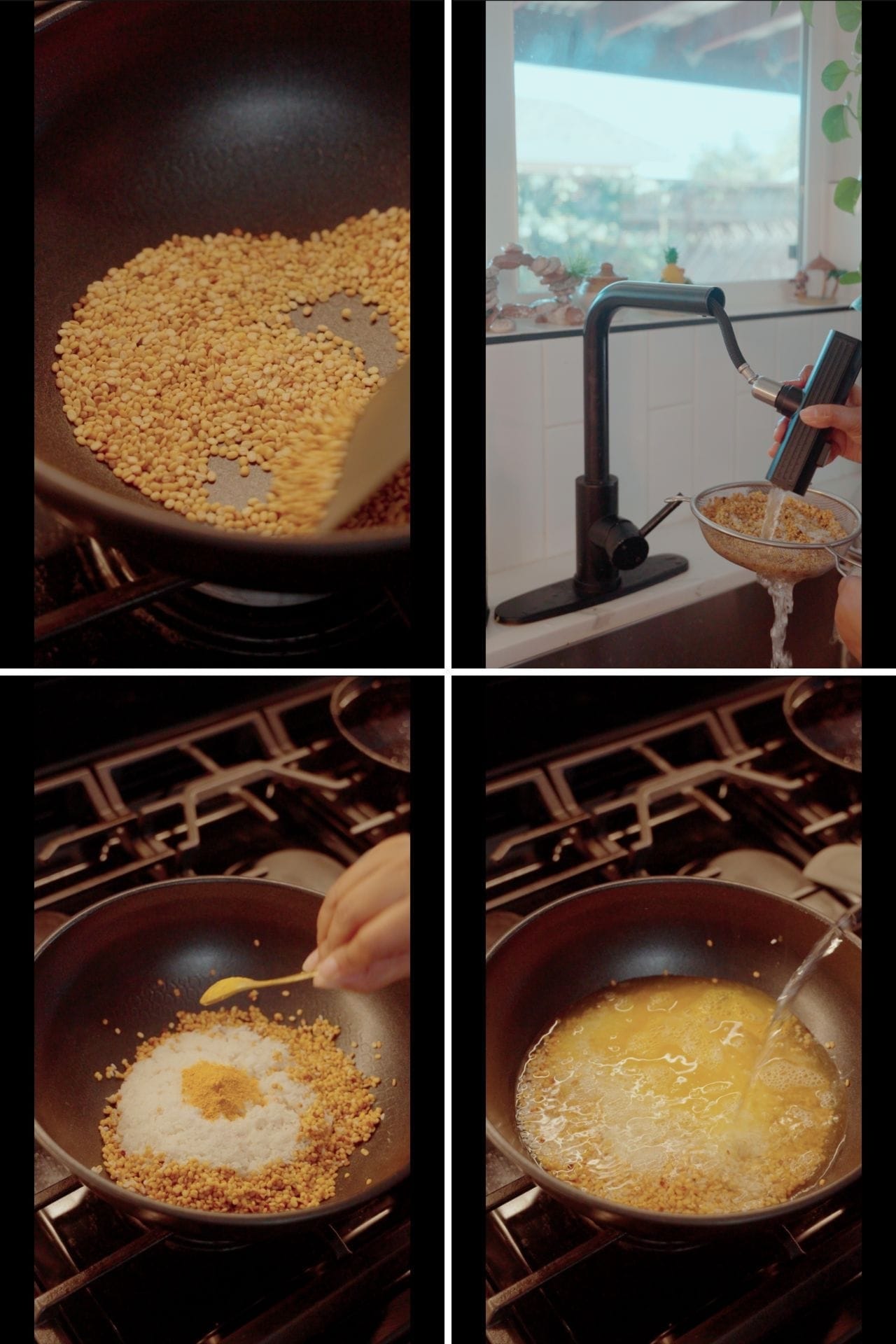
Place a dry, heavy-bottomed skillet over medium-low heat.
Add the moong dal. There is no need to add oil or ghee.
Start stirring the dal. At first, the lentils will look exactly as they did when you put them in the pan.
Gradually, they will begin to smell toasted. Keep stirring so that the lentils roast evenly.
You are looking for a light golden color and a beautiful nutty aroma. Don't wait until every lentil becomes dark golden brown.
The aroma is more important than the color.
Once the dal smells fragrant, immediately transfer it to a plate or bowl so that the residual heat from the pan doesn't continue cooking it.
Step 2: Wash the Roasted Dal
Allow the dal to cool for a few minutes. Then rinse it gently under cool water.
This removes any excess dust and loose particles while preserving the roasted character of the lentils.
Don't aggressively scrub the dal.
Step 3: Wash the Rice
Rinse the rice several times until the water becomes considerably clearer.
You don't necessarily need perfectly transparent water, but removing some of the excess surface starch helps you control the final texture.
Drain well.
Step 4: Combine Rice and Dal
Add the washed rice and roasted moong dal to a large saucepan.
Add the water.
Bring the mixture to a boil over medium-high heat. Once it begins boiling, reduce the heat.
You want a gentle simmer.
Step 5: Add Turmeric and Salt
Add turmeric and salt.
Stir gently.
At this point, the kitchen should already start smelling wonderful because the roasted dal is beginning to release its aroma into the cooking liquid.
Step 6: Cook Until Soft
Allow the rice and dal to cook gently until both are completely tender.
Stir occasionally.
The cooking time will vary depending on the rice, the dal, your saucepan, and how vigorously the mixture is simmering.
Don't obsess over a precise number of minutes. Instead, look at the food.
The rice should be soft. The dal should be completely tender.
The mixture should be cohesive and creamy.
If the rice and dal are still firm but the pot looks dry, add a little hot water.
Step 7: Make the Ghee Tempering
This is the part that makes the whole kitchen smell incredible.
Heat ghee in a small pan. Add the bay leaves and dried red chilies. Then add the panch phoron.
As soon as the whole spices hit the hot ghee, they will begin to sizzle.
Add the chopped ginger. Let everything cook briefly.
You want the spices to become fragrant. You do not want the panch phoron or ginger to burn.
Step 8: Add the Tempering to the Khichuri
Pour the hot ghee and spice mixture over the cooked khichuri.
You will immediately smell the ginger, whole spices, and ghee. Give everything a gentle stir.
Taste for salt. If needed, add a little more.
Let the khichuri rest for a couple of minutes before serving.
The Secret to Really Good Bengali Khichuri
If I had to reduce the entire recipe to a few important points, they would be these:
Roast the dal properly - This is the foundation.
Don't burn the spices - The final tempering should smell fragrant, not bitter.
Use short-grain rice if possible - It creates a much better texture.
Keep extra hot water nearby - You have much more control when you add liquid gradually.
Don't make it too thick - Remember that it will continue absorbing liquid.
Finish with ghee - That final aromatic layer makes a huge difference.
What Does Bengali Khichuri Taste Like?
If you've never had Bengali khichuri, you might expect it to taste like a typical heavily spiced Indian khichdi.
This version is different.
The flavor is mellow, nutty, aromatic, and comforting.
The roasted moong dal gives the dish a toasted flavor.
The rice provides softness and subtle sweetness.
Turmeric brings earthiness and color.
Ginger adds warmth.
Panch phoron contributes a complex aroma without making the dish aggressively spicy.
And ghee ties everything together.
The beauty of this dish is that no single ingredient overwhelms the others.
What to Serve with Bhaja Mung Dal Khichuri
A bowl of khichuri is wonderful on its own, but Bengali meals are often about the combination of textures and flavors.
Khichuri is soft and comforting.
So the best accompaniments often bring crunch, crispness, acidity, sweetness, or heat.
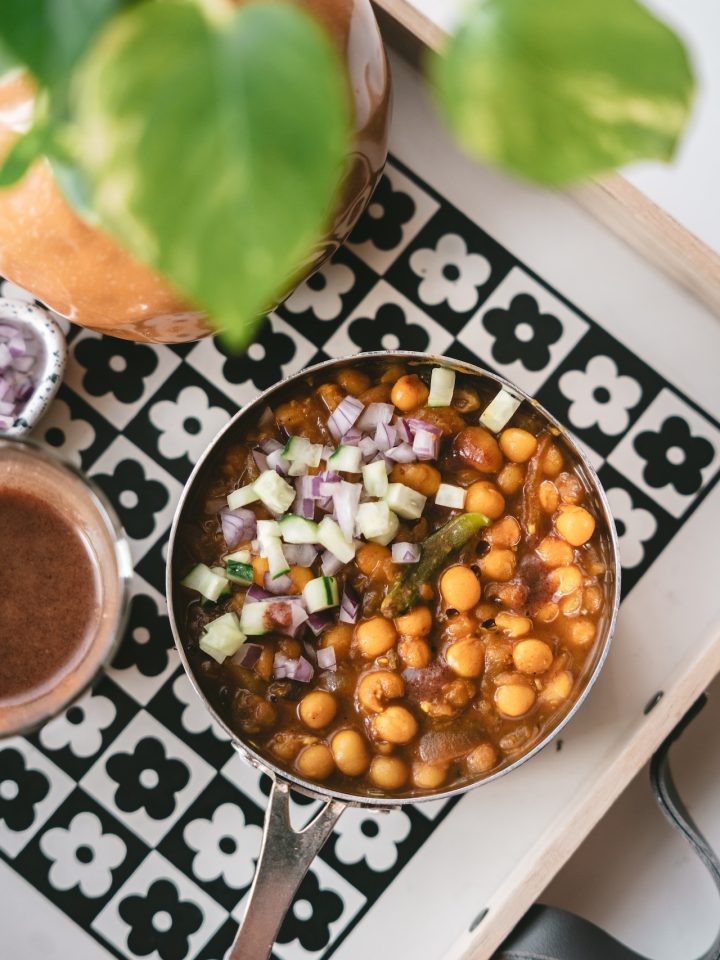
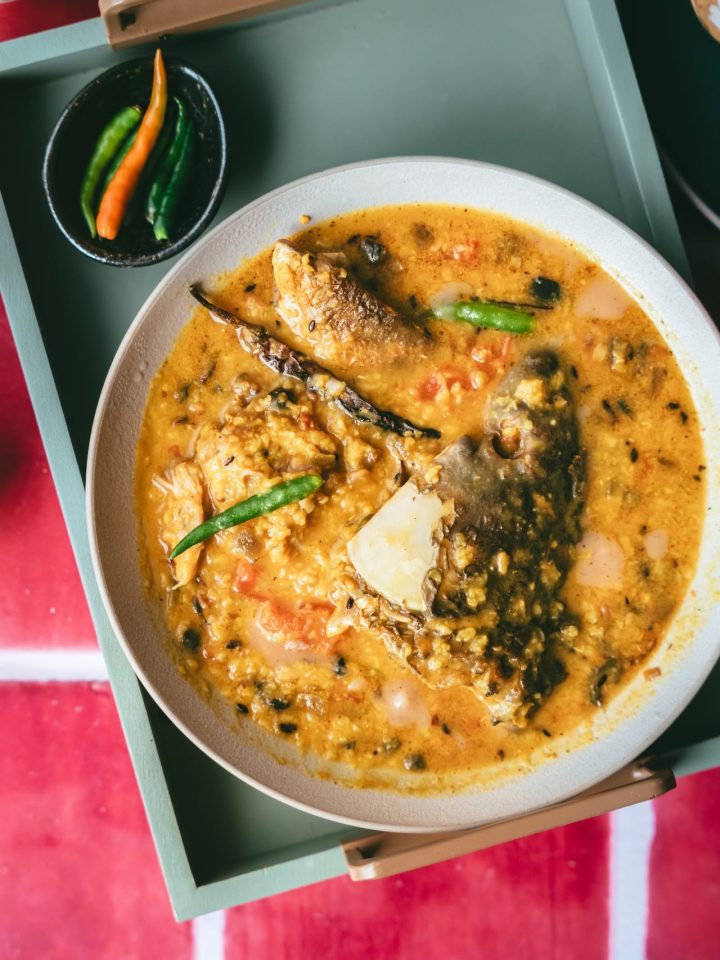
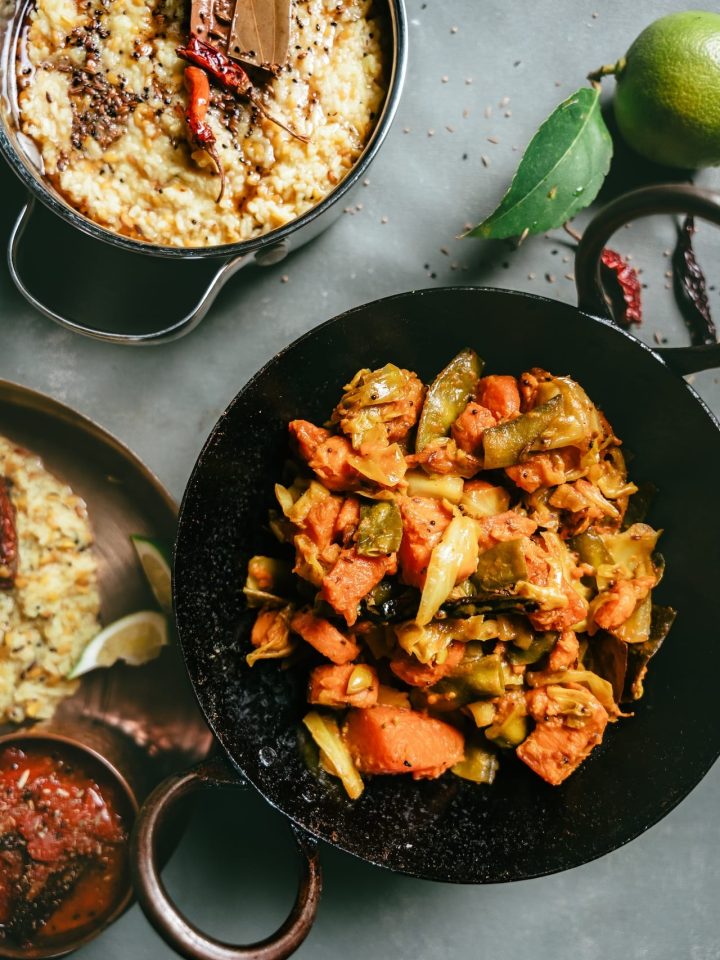
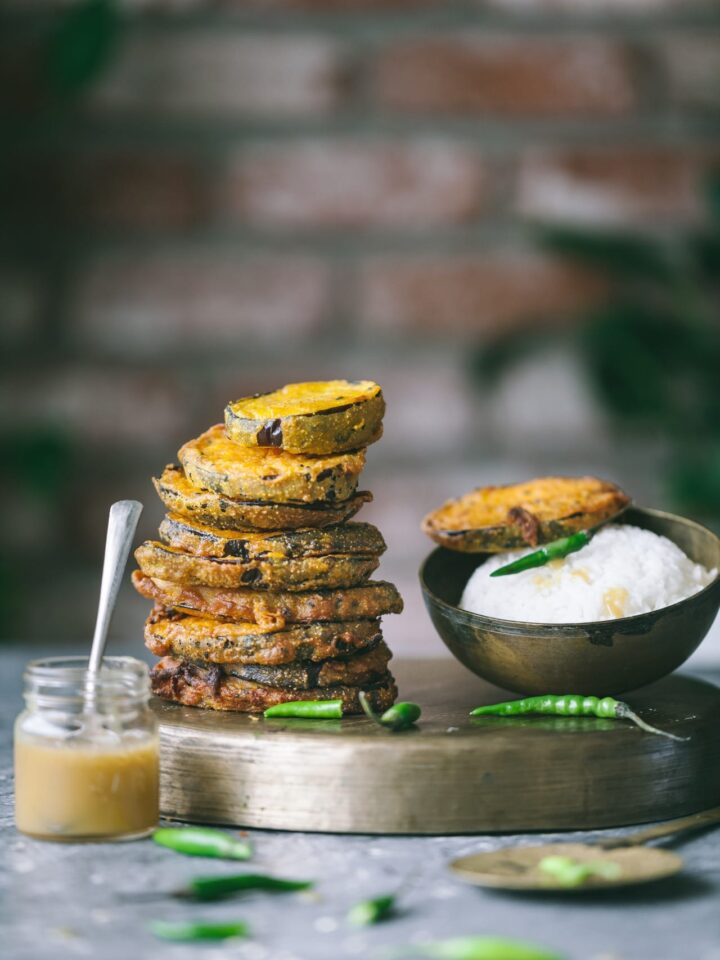
Pair it with Begun Bhaja, Labra, Papad, Mango Pickle, Aloo Bhaja,
Can You Make This Khichuri in a Pressure Cooker?
Yes.
Pressure cooking is a convenient way to make khichuri, particularly when you are short on time.
The important thing is to remember that pressure cooking traps more moisture than an uncovered saucepan.
So don't blindly transfer the exact liquid ratio from the stovetop method.
Start conservatively.
You can always loosen the cooked khichuri with hot water.
Why Did My Khichuri Become Too Thick?
There are several reasons.
The most common is simply that the rice continued absorbing water.
Other possibilities include:
- Too little cooking liquid.
- Cooking for too long.
- Using a rice variety that absorbs more water.
- Letting the khichuri sit uncovered.
The good news is that thick khichuri is very easy to fix.
Add hot water gradually and stir until you reach the desired consistency.
Frequently Asked Questions
Bhaja generally refers to something that has been fried or roasted. In this recipe, it refers specifically to the dry-roasting of the moong dal before cooking.
Yellow split moong dal is one of the most traditional and flavorful choices, particularly when it is roasted before cooking.
For this recipe, soaking isn't necessary. The dal is roasted first and then rinsed before cooking.
Panch phoron is a Bengali whole-spice blend traditionally made from fenugreek, fennel, cumin, black mustard, and nigella seeds.
Khichuri combines rice and lentils in one dish, providing carbohydrates and plant-based protein. The nutritional profile will depend on the quantities of rice, dal, ghee, and other ingredients used.
Bhaja Mung Daal Khichuri (Roasted Lentil and Rice Stew)

Ingredients
- ½ cup yellow spilt lentils (moong daal)
- ½ cup short grain rice
- 3 cups water
- ½ teaspoon turmeric powder
- salt to taste
For tempering
- 2 tablespoon ghee
- 2 bay leaves
- 3 dry red chilies
- 1 teaspoon panch phoron (Bengali five spice)
- 1 inch ginger (finely chopped)
- salt
Instructions
- Roast the moong dalAdd the dry moong dal to a dry skillet.Roast over medium-low heat, stirring frequently, until the dal becomes fragrant and lightly golden.Be careful not to burn it.Remove from the heat.
- RinseAllow the dal to cool slightly.Rinse the roasted dal gently.Wash the rice separately.Drain both.
- CookPlace the rice and roasted moong dal in a saucepan.Add the water.Bring to a boil.Reduce the heat and simmer gently.
- SeasonAdd turmeric and salt.Continue cooking until the rice and dal are completely soft.Add additional hot water if necessary.
- Make the temperingHeat ghee in a small pan.Add bay leaves, dried red chilies, panch phoron, and chopped ginger.Cook until fragrant.Do not burn the spices.
- FinishPour the hot tempering over the cooked khichuri.Stir gently.Taste and adjust salt.Rest for a couple of minutes.
- Serve hot with begun bhaja, labra, papad, pickle, or your favorite Bengali sides.
Deepa
I love khichri and the south indian version pongal, this with a bit of ghee and lemon pickle is my comfort food. I am going to try your version today itself K 🙂
Cygnet Kitchen
I have a friend coming for lunch this week, she would love this! I have a great asian spice store near me so I am going to try and get some radhuni for the Bengali 5 spice, I have everything else. Could I use ajwain which I do have, if I can't get radhuni? Gorgeous photos as always!
Gaurav Sharma
My mother made Kichdiee very interesting. But it was made only when someone is falling ill in my house as we all know that it is easy to digest and I also eat Kichdiee with full of ghee and masalas. But as we live in North India we do not use what you describe
Bengali Five Spice. Will definitely tried your version
Kate @MyLittleLarder
I just found your site after you posted a comment on my blog. I am so pleased you did because your site is beautiful! Stunning, stunning photography and gorgeous food. I'll be back!
Bina
The rice-mung bean combination with ghee is a favorite of mine be it khichdi or Pongal. Will definitely try this Bengali version too, Kankana. Stunning pictures as always 🙂
Mallika
Kichuri or Khichdi as we call is the most humble meal. You've made it look exotic. My version is similar to your's, but addition of Bengali 5 spice is new. I should give this a try. BTW, I love those broken pieces of papad in your photos. They add such a depth overall.
nicole branan
This stew sounds incredibly delicious and you styled and photographed it beautifully! Thanks so much for sharing, Kankana. 🙂
dixya @ food, pleasu
this is exactly the kind of meal i crave for...i recently made something similar with steel cut oat and mung beans, came out so luscious! your version looks wonderful.
Cheyanne @ No Spoon
I actually really adore lentils and feel like they don't get enough love, so thanks for sharing this! This roasted lentil and rice stew looks absolutely delicious!! SO much flavor going on here! Love Love Love this! Beautiful pictures, too! Cheers and thanks for sharing the YUM! 🙂
Pang {circahappy}
As always, I LOVE LOVE LOVE your photographs SO VERY MUCH, Kankana. 🙂
Laura (Tutti Dolci)
Such a comforting and fragrant dish!
Shirley
Love lentils, so Im going to make this. I have lots of spices to make Indian dishes, but no panch phoron. Is there a substitute for the panch phoron (Bengali five spice)?
Kankana Saxena
Panch phoron is easy to make at home. It's a combination of 5 common whole spices. You could however substitute panch phoron with just cumin seeds and fennel seeds probably. Although the flavor will be slightly different but it would still taste quite nice.
angiesrecipes
I am a HUGE fan of lentils...this stew looks hearty, comforting and delicious!
Linda Morris
I have an intolerance to lentils so is there anything you can suggest that I could replace them with as this recipe is right up my street. I do not do well with all legumes but tolerate rice very well.
Kankana Saxena
Sadly the two key ingredients that makes this dish is lentil and rice. You could probably try using some kind of beans but in that case you have to cook the beans separately and then cook it along with rice. I am not sure if that will work as I haven't tried that. The taste will however be quite different!
Linda Morris
Thanks for the reply but unfortunately, as I said previously, I am intolerant to all legumes so beans would no be an option for me. If I ever do make this dish and substitute lentils for something else with success I will let you know.